
Stay Safe
Protect yourself, patients, clients, and bystanders during difficult situations.
For parents, teachers, coaches, employees, and anyone who wants to be prepared.
View courseAHA BLS certification for nurses, EMTs, dental staff, medical assistants, and healthcare workers.
View courseStart online and complete the skills check in person.
RegisterTraining for childcare providers, preschool staff, and daycare professionals.
View courseOn-site CPR, First Aid, and BLS for businesses, schools, churches, and organizations.
Learn moreMAB / CPI CRISIS PREVENTION
Management of Assaultive Behavior and crisis prevention training. Learn to recognize warning signs early, de-escalate with calm communication, protect personal safety, and respond professionally to aggressive or escalating behavior.
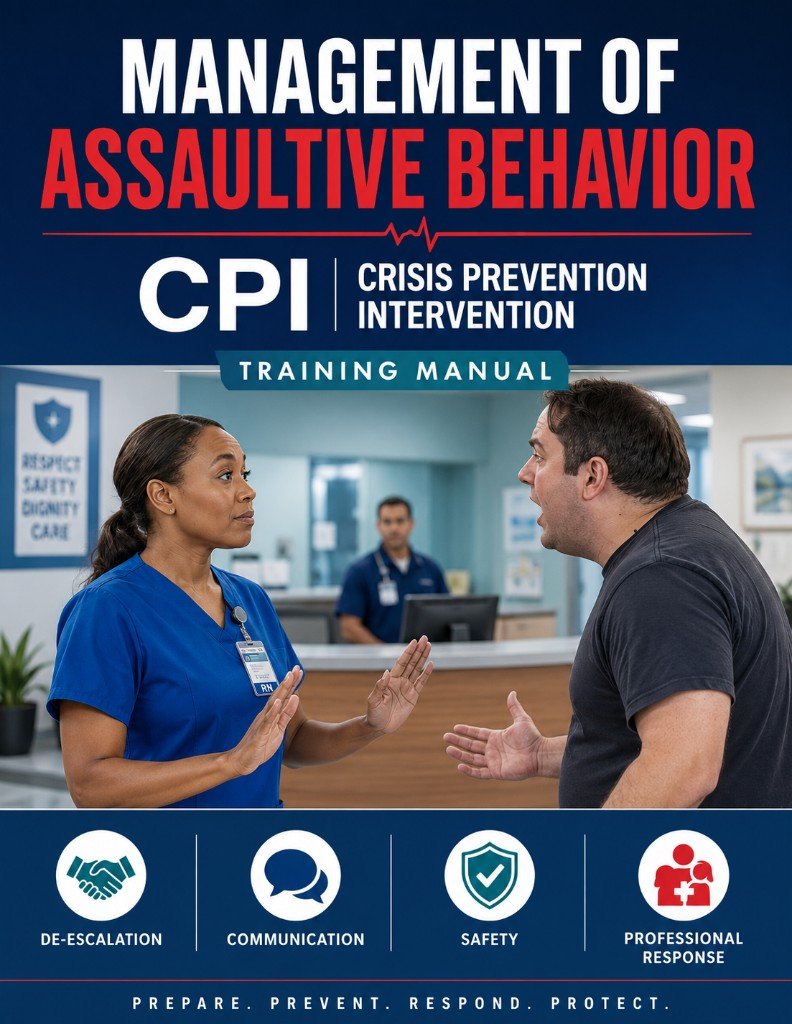
Protect yourself, patients, clients, and bystanders during difficult situations.
Use calm communication and respectful limit-setting to reduce tension.
Identify warning signs of escalation before a situation becomes physical.
Meets common healthcare and behavioral health employer requirements.

This course is built around prevention first—recognizing warning signs early, using respectful communication, reducing tension, and protecting personal safety.
Audience
Workplace & Healthcare Staff
Focus
Prevention & Safety
Class Format
In-Person / On-Site
The MAB / CPI Crisis Prevention Course is designed to help healthcare workers, behavioral health staff, school employees, security personnel, workplace teams, and other professionals recognize, prevent, and respond to aggressive or escalating behavior. This course focuses on Management of Assaultive Behavior, crisis prevention, de-escalation, workplace violence awareness, personal safety, communication skills, and professional response during difficult or potentially unsafe situations.
At CPR and First Aid Training School, our goal is to provide practical training that helps students stay calm, think clearly, and respond safely when a person becomes angry, threatening, confused, combative, emotionally distressed, or physically aggressive. The course is built around prevention first. The best outcome is always to recognize warning signs early, use respectful communication, reduce tension, protect personal safety, and prevent a situation from becoming violent whenever possible.
MAB stands for Management of Assaultive Behavior. CPI is commonly used in the industry to refer to crisis prevention and crisis intervention training. This course is designed for students who need training in de-escalation, workplace violence prevention, aggressive behavior response, patient safety, staff safety, and crisis communication.
MAB / CPI Crisis Prevention Training teaches students how to identify behaviors that may lead to aggression or violence and how to respond in a safe, professional, and controlled manner. The course focuses on prevention, awareness, communication, and response. Students learn how to recognize early warning signs, use verbal de-escalation techniques, maintain safe distance, understand personal space, avoid power struggles, call for help, report incidents, and protect themselves and others.
This type of training is especially important in healthcare and behavioral settings where staff may work with patients, clients, visitors, or residents who are upset, confused, under the influence, in pain, emotionally overwhelmed, or experiencing a mental health crisis. It is also useful for school staff, security officers, front desk employees, social service workers, transportation staff, and anyone who may come into contact with aggressive or unpredictable behavior.
The purpose of this training is not to teach students to fight. The purpose is to teach students how to prevent escalation, reduce risk, and respond appropriately when a situation becomes unsafe. Safety, professionalism, communication, and documentation are key parts of the course.
This course is recommended for professionals who may encounter aggressive, assaultive, disruptive, or escalating behavior in the workplace. This may include healthcare workers, nurses, medical assistants, hospital staff, emergency room personnel, behavioral health workers, psychiatric facility staff, dental office staff, urgent care staff, clinic employees, security officers, school staff, childcare workers, social service employees, residential care workers, group home staff, transportation workers, and workplace safety teams.
Many healthcare and behavioral health employers require employees to complete Management of Assaultive Behavior or workplace violence prevention training. In some settings, employees may need this training before starting work, during orientation, or as part of annual renewal requirements.
This course is also helpful for business owners and managers who want to improve workplace safety, reduce risk, and prepare employees to handle difficult situations professionally.
Aggressive behavior can happen in many environments. A patient may become upset about wait times, pain, medication, family stress, confusion, fear, or mental health symptoms. A visitor may become angry at staff. A client may refuse instructions. A student may become emotionally overwhelmed. A customer may threaten an employee. These situations can become dangerous when staff are not prepared.
Training helps employees recognize the early signs of escalation before the situation becomes worse. It also teaches staff how their own body language, tone of voice, word choice, and positioning can either calm a situation down or unintentionally make it worse.
MAB / CPI-style training matters because it gives students a plan. Instead of reacting with fear, anger, or confusion, trained staff can follow a safer process: assess the situation, maintain distance, communicate calmly, set respectful limits, request assistance, protect escape routes, avoid unnecessary physical contact, and report the incident properly.
The goal is to protect everyone involved, including staff, patients, clients, students, visitors, and bystanders.
The MAB / CPI Crisis Prevention Course covers the major topics needed to recognize, prevent, and respond to aggressive behavior. Students learn about workplace violence awareness, crisis development, verbal de-escalation, nonverbal communication, personal safety, environmental awareness, emergency response, reporting, and post-incident review.
A major part of the course is understanding the stages of escalation. Many aggressive incidents do not begin with violence. They often begin with frustration, anxiety, confusion, fear, verbal hostility, refusal, pacing, yelling, clenched fists, threatening language, or invasion of personal space. When staff learn to recognize these signs early, they may be able to intervene before the situation becomes physical.
Students also learn about communication. Words matter during a crisis. Tone matters. Body language matters. The way a staff member stands, speaks, listens, and responds can influence the direction of the situation. This course teaches students to use calm communication, respectful limit-setting, active listening, and clear instructions.
The course also reviews safety principles, including maintaining a safe distance, avoiding cornering a person, keeping an exit path available, removing unnecessary bystanders, calling for help early, and knowing when to disengage. Students learn that personal safety is always a priority.
One of the most important parts of this course is learning how to recognize warning signs. Aggressive behavior often has clues before it becomes physical. These warning signs may include raised voice, rapid speech, refusal to follow directions, verbal threats, insults, staring, pacing, clenched jaw, clenched fists, sudden silence, invasion of personal space, agitation, confusion, or sudden changes in behavior.
Students learn to observe both verbal and nonverbal signs. A person may say they are fine, but their body language may show anger, fear, or agitation. A person may become quiet, tense, or withdrawn before acting out. Recognizing these changes can help staff respond sooner and more safely.
The course teaches students to take warning signs seriously. Even if a situation does not become violent, early intervention can reduce stress, protect staff, and improve the outcome.
Verbal de-escalation is a central part of MAB / CPI-style training. De-escalation means using communication and behavior to reduce tension and help the person regain control. The goal is to lower the emotional intensity of the situation.
Students learn to speak calmly, avoid arguing, listen carefully, acknowledge feelings, set clear boundaries, offer choices when appropriate, and avoid language that sounds threatening or disrespectful. In many situations, a person who feels heard and respected may become less defensive.
De-escalation does not mean allowing unsafe behavior. Staff can be respectful while still setting limits. For example, a staff member may calmly say that they want to help, but they cannot allow threats, physical aggression, or unsafe conduct. The course teaches students how to set limits without escalating the situation further.
Students also learn what not to do. Staff should avoid yelling, sarcasm, insults, sudden movements, crowding the person, touching without permission, arguing over minor details, or making promises they cannot keep. These actions can increase tension and make the situation worse.
During a crisis, nonverbal communication can be just as important as spoken words. A person in crisis may react strongly to facial expressions, posture, gestures, distance, and movement. Students learn how to use nonthreatening body language, calm facial expressions, open posture, and safe positioning.
Personal space is also important. Standing too close can make a person feel trapped or challenged. Standing too far away may make communication difficult. The course teaches students to maintain a safe and respectful distance based on the environment and level of risk.
Students also learn to position themselves safely. This may include keeping a clear exit route, avoiding being backed into a corner, staying aware of objects that could be used as weapons, and avoiding situations where they are alone with a highly aggressive person when help is needed.
Safety begins before physical aggression happens. The more aware staff are of the environment, the better they can prevent injury.
When behavior becomes threatening or assaultive, staff must respond quickly and professionally. The course teaches students to recognize when a situation has moved beyond simple communication and requires additional support.
Students learn the importance of calling for help, following workplace policy, activating emergency response procedures, protecting bystanders, and moving to safety when needed. If a person becomes physically aggressive, staff should avoid unnecessary physical confrontation and follow the approved procedures of their workplace.
The course emphasizes that staff should never put themselves in unnecessary danger. The goal is to reduce harm, not to overpower or punish the person. Professional response means using the safest option available, based on training, policy, and the immediate risk.
Students are also reminded that every workplace may have different procedures. Hospitals, clinics, schools, security teams, and behavioral health facilities may each have their own emergency plans. Employees should know and follow their organization’s policies.
Workplace violence prevention is an important part of this course. Students learn that workplace violence can include verbal threats, intimidation, harassment, physical assault, stalking, aggressive behavior, and other unsafe conduct. In healthcare and public-facing settings, employees may face risk from patients, clients, visitors, customers, coworkers, or other individuals.
Prevention begins with awareness. Staff should understand their workplace risks, know how to report concerns, recognize unsafe patterns, and participate in a culture of safety. Training helps employees understand that reporting incidents is not just paperwork. Reporting helps organizations identify trends, improve procedures, and protect staff.
Students learn the importance of documenting incidents clearly and objectively. Documentation may include what happened, what was said, who was involved, what actions were taken, whether injuries occurred, and who was notified. Accurate documentation helps protect employees, organizations, and the people being served.
After an incident, the response is not over. Staff may need medical attention, emotional support, supervisor notification, incident reporting, witness statements, and a review of what happened. The course teaches students that post-incident follow-up is important for safety and improvement.
A post-incident review can help answer important questions. What were the warning signs? What actions helped? What actions did not help? Was help called early enough? Were policies followed? Were there environmental risks? What can be changed to reduce future incidents?
Students also learn that aggressive incidents can affect staff emotionally. Fear, stress, frustration, and anxiety after an incident are normal. Organizations should support employees and use incidents as learning opportunities.
Students taking this course should be prepared to participate in discussion, scenario-based learning, communication exercises, and safety demonstrations. Depending on the course format, students may practice verbal de-escalation, active listening, setting boundaries, recognizing warning signs, safe positioning, calling for help, reporting incidents, and responding to workplace violence scenarios.
Scenarios help students apply what they learn. A student may practice responding to an angry visitor, a confused patient, a threatening customer, an agitated client, or a person refusing directions. These practice situations help students build confidence before facing a real incident.
The goal is not to make students aggressive. The goal is to make students prepared, calm, observant, and professional.
Many employers require MAB, CPI-style, crisis prevention, or workplace violence prevention training before an employee begins work. Some employers require annual renewal, especially in healthcare, behavioral health, emergency care, and high-risk workplace settings.
Students should check with their employer, licensing program, or facility to confirm the exact type of training required. Requirements may vary depending on the job, workplace, and certifying organization. CPR and First Aid Training School can help students understand available course options and choose training that fits their professional needs.
CPR and First Aid Training School offers MAB / CPI-style Crisis Prevention Training for individuals and organizations that need practical instruction in de-escalation, workplace violence prevention, aggressive behavior response, and professional crisis communication.
Students who complete this course should leave with a stronger understanding of warning signs, verbal de-escalation, personal safety, workplace violence awareness, documentation, and safe response during aggressive or escalating situations.
If you work in healthcare, behavioral health, education, security, customer service, or any setting where aggressive behavior may occur, MAB / CPI Crisis Prevention Training is an important step in building readiness, confidence, and workplace safety.
“The de-escalation training gave me real tools I now use with agitated patients. Very practical.”
“Great scenario practice. I feel more confident recognizing warning signs early.”
“Our whole team took the on-site class. Calm, professional, and very relevant to our work.”
Call (562) 269-0775 or reserve your seat today. Individual and on-site group training available.